Showing posts with label Perodua. Show all posts

November 21, 2017

SHOWROOM: 2018 Perodua Myvi !

The baby Myvi that has been flooding Malaysia's roads for over a decade is no longer a baby anymore. I was surprised on how much the all-new 2018 Perodua Myvi has grown compared to its predecessor when I first lay eyes on it in the showroom. The changes are apparent. 3,895mm long, 1,735mm wide, 1,515mm tall with a wheelbase of 2,500mm, it has grown 205mm longer, 70mm wider, 60mm longer wheelbase but a mere 30mm lower for a sportier stance without sacrificing cabin space. More on this later :)

Features wise, it is impressive, I mean IMPRESSIVE! The most impressive would be the Advanced Safety Assist (ASA) for the Myvi 1.5 Advance. At RM55,300, the Myvi 1.5 Advance is the cheapest car you can get with autonomous braking technology in Malaysia at the moment. The next would be the Hyundai Ioniq Plus, priced at more than the RM100k mark. 

Exterior design of the Myvi has been an evolution. For the first time ever, the taillights of the Myvi has been switched from vertical to horizontal, making its way into the tailgate. There is also small glass area after the C-pillar, which contributed to the enlarged stance but will also promote better rear view visibility. With the 15-inch alloys on the 1.5, the Myvi has potential to be a hot hatch with larger spoiler and all-round bodykits!


The door opened with a light pull on the door handle, showing the redesigned, more modern dashboard. Some cues of Honda City's dashboard can be seen, especially around the air-cond vents area. Overall, the cabin feels well built, albeit a little plasticky and some silver trims on the door seems to have rough finishing appearance. But well, we can't complain much for a car of its price. 

There is also a slot to insert your toll card and a digital display to read the balance under the wing mirror adjuster. The transmitter (like our Smart Tag) is on the right side of the dashboard, I wonder will it be able to transmit the signal if the owner installed thick tint on the windscreen. 


Boot space has increased from 208 litres to 277 litres, it's one step closer to the class leading Honda Jazz, enabling the Myvi to fit in 4 cabin luggage bags with ease. A boon for Uber/Grab drivers I would say. 


For people who have sat in a Myvi before will know how spacious the cabin is. With a longer wheelbase for this all-new Myvi, I can officially announce that I am able to put my leg up like a boss at the back seat, with the front seat adjusted to my 180cm height! Headroom is not a problem as well, eventhough the roof line has been lowered for a more aerodynamic and sportier outlook. 


By the way, the Peppermint Green (which looks like light blue) colour scheme looks refreshing (no pun intended). Too bad I do not have a photo to show you guys. It's an attractive colour which can be taken care easily. So, what do you think about the all-new Myvi? This 3rd generation Myvi definitely will win a lot of Malaysians' heart again.  

*Thanks for reading! Please like my page at SimonHar.com and subscribe SiMon HaR_!

December 18, 2014

2015 Perodua Myvi Facelift Spied !

The B-segment hatchback market has become very competitive between our two national car manufacturers. To ensure Perodua doesn't fall behind in the fight, Perodua is prepping its triumph card - the Myvi, with a facelift for year 2015. Spotted somewhere which looks like a car storage yard, the Myvi (should be 1.5) shown in this article gained a nose job. The projector headlights and fog lights retained, but the radiator grille has grew larger and meaner. Eagle eyes will notice the additional front parking sensor.

The rear, on the other hand, received subtle changes. Clear lense taillights (1.3 should be red-in-colour) and a new rear bumper. The alloy rims doesn't seems to get a change in size, but the design is now turbine-like.


The cabin received a newly-designed meter cluster, head unit and rumour has it that Perodua added in ECON button for the Myvi.

Will these changes adequate to allow the Myvi to conquer the market again? Hmm... Hard to say.

*Thanks for reading! Please like my page at SimonHar.com and subscribe SiMon HaR_!

September 17, 2014

FIRST IMPRESSION: Perodua Axia !

Perodua Axia, say "Ah-see-ya"! Read the name in our national language and you will find yourself saying 'Asia'. Nevertheless, it's a great name for one of the most affordable cars you can get in Malaysia. With price starting from RM24,600 OTR, many Malaysian can now own a car. The Axia is the replacement model of Viva, but somehow Viva is still selling in the market with its entry model selling at RM22k. However, the entry model Axia Standard E manual, which is just roughly RM3k dearer than the cheapest Viva, makes the former a hard car to ignore.

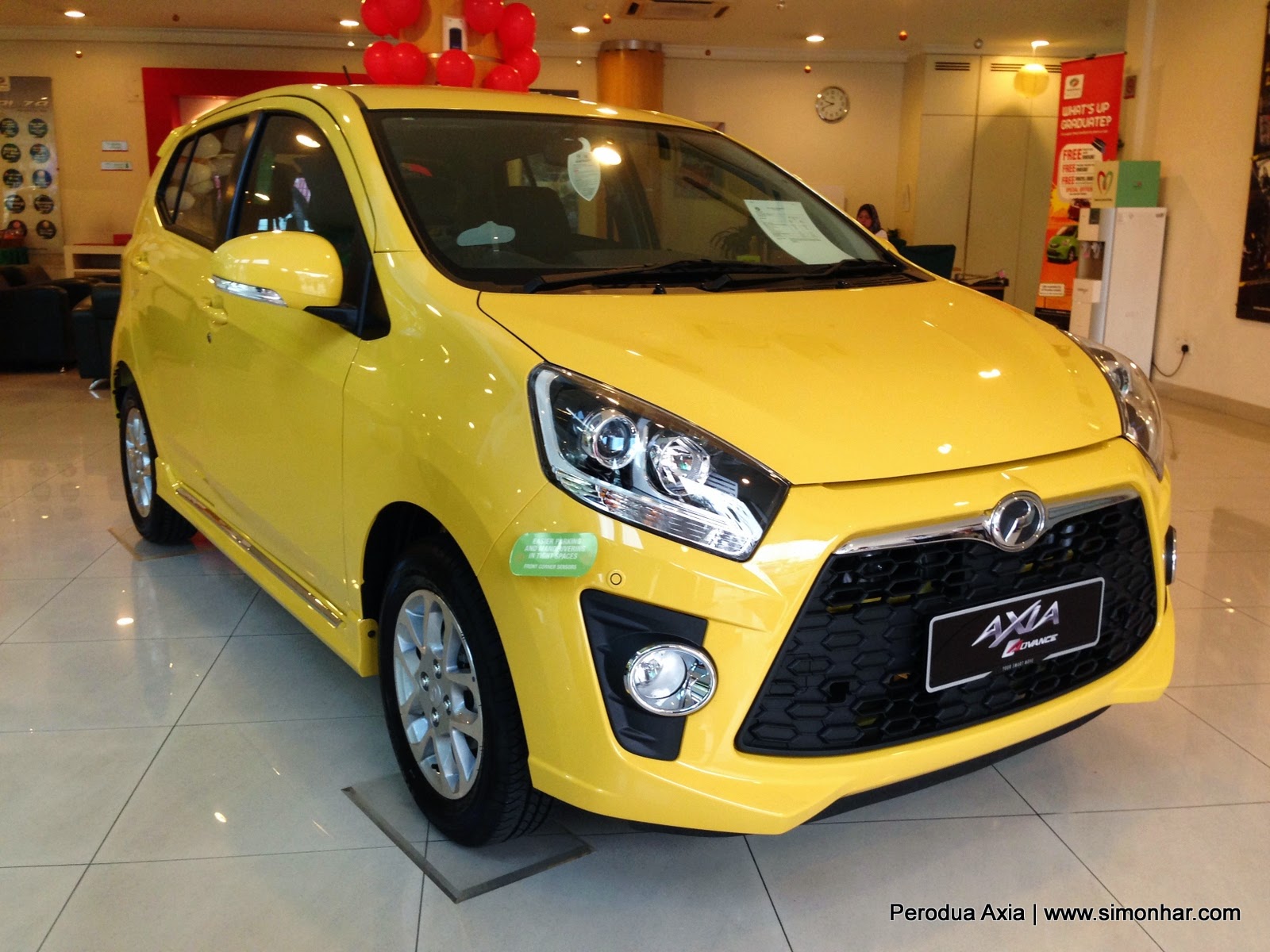
Perodua Axia, which has been granted the status of the first energy efficient vehicle (EEV) in Malaysia, has been given two faces - a cute, jovial face for the Standard E and G variants (above), and a more aggressive looking face for the SE and Advance (AV) variants (below). Which has the better look? In my opinion, the jovial looking front end suits better to this A-segment hatchback. However, the projector headlights and honeycomb grille on the SE and AV variants give the car a more upmarket design. 


The Axia is 3640mm long, 1620mm wide, 1510mm tall and comes with a 2455mm wheelbase. Surprise, surprise. The wheelbase of the Axia is actually 15mm longer than the Myvi's! Axia's interior length (+50mm) and width (+5mm) are than Myvi too! However, if compared with Viva, the difference is apparent. Perodua Axia is 65mm longer, 145mm wider, has a 65mm longer wheebase but is 20mm lower in terms of overall height. 

The brilliant packaging by the engineers also allow 4 suitcases to be fitted into the 260 litres boot, and we are talking about those big suitcases you will find in the airport! The boot looks averagely sized in person, but somehow it is capable of swallow more stuff than the upcoming Proton B-segment hatchback! 


Every variant is powered by the same 1.0 litre all-aluminium, 3-cylinder engine. It produces 66bhp at 6000rpm and 90Nm of torque at 3600rpm, mated to either a 4-speed automatic transmission or a 5-speed manual transmission. Both transmission are capable of achieving fuel consumption rating of 20.1km/l and 21.6km/l respectively in ECO mode, pretty impressive. I guess the Electric Power Steering (EPS) helps too. 

Cabin is where the Axia excels. Spacious for 4 full-sized adults, 5 at a squeeze (just a little). The rear headroom somehow felt more ample than the Myvi's. Cabin is wide for a small car like this, thanks to the thin door and door panels, but this contributed a sense of 'lightness' to the doors and they doesn't give a reassuring thud when closed. Material wise, hard plastics dominated the cabin but at least they doesn't look or feel cheap. Even the entry level's steering wheel felt good to the touch and the fabric seats are well sized and comfy!

What's weird is that the steering doesn't have tilt or telescopic adjustment. I was fondling around underneath the steering rack for quite a long time, trying to find the adjustment lever but to no avail. One thing though, I doubt the air-cond knobs' plastic labels will be able to stand the scorching heat in Malaysia as one of the showroom's unit already has bubble in it. 
From top: 1.0AV, 1.0SE and 1.0G.


Perodua upped the game by increasing the practicality and flexibility of the Axia's seating arrangement. You can fold flat the rear seat, or fold the front seats backward into a lounge. Not as cool as Honda's ULTRA-seat, but still better than nothing.


A nifty feature designed by Malaysian, for Malaysian. A handbag lock that can take a maximum of 3kg located at the inner side of the front passenger seat. At least now female drivers can have a place to hang their handbags instead of placing them on the seat. There's also an integrated tissue box holder at the back of the front passenger seat. It's good to prevent some people from putting the tissue box on top of the dashboard, where the airbag is located.


Perodua Axia has been rated 4-star in ASEAN-NCAP crash test and is equipped with two airbags across the range. However, ABS, EBD and BA is only available in 1.0SE and 1.0AV. No stability control available, not even as optional. One worth mentioning is the availability of front parking sensor for 1.0SE and 1.0AV. 

So there you have it, the affordable and value-for-money Perodua Axia. For the first time Perodua is also offering five-year or 150,000km warranty for the Axia, and the deal extended to Myvi and Alza too! All these make the Viva dull in comparison and the Axia a more sensible purchase, maybe better than a Myvi too... 

*Thanks for reading! Please like my page at SimonHar.com and subscribe SiMon HaR_!

August 15, 2014

Perodua Axia Open for Booking - From RM24,900!

 From RM24,900? It's like Perodua Kancil all over again, but the all-new Perodua Axia is much more better equipped, better looking and not to mention a larger cabin too! Malaysia's first Energy Efficient Vehicle (EEV) is now open for booking with a booking fee from as low as RM250. 

Perodua Axia comes with 4 variants, where the entry-level E grade is only available with manual transmission while the top-of-the-line AV grade comes with only automatic transmission. Can't drive a stick? Have to start your options from the G grade. Measuring at 3640mm long, 1620mm wide and 1510mm tall, the Axia position itself in between the Viva and Myvi, not sure Viva will be sold along with the Axia in the future or not though. With 260 litres of boot space, that's larger than a Myvi's!


Perodua Axia is powered by a 1.0litre 1KR-DE2 engine which produces 66hp at 6000rpm and 90Nm of torque at a low 3600rpm. Together with the help of Electric Power Steering (EPS), the manual transmission Axia is able to achieve fuel consumption figure of 21.6km/l, a very impressive figure. 

SE and Advance grade are for those who need more features and style, as they will receive a sportier front bumper design, side skirting with chrome finishing and rear spoiler. It shocked me that the SE grade will have front parking sensor, a first in its class. It might be cool to have, but is it necessary to have a front parking sensor for a sub 4-meter long compact car? Advance grade is a little over-specced, unless you have a crush for leather seats and touchscreen multimedia audio system. 

Safety wise, 2 airbags are standard across the range, kudos to Perodua. ABS with EBD and BA are only available from SE grade onwards. Perodua claims the Axia is able to achieve 4-star in ASEAN NCAP crash test, presumably the Axia has gone through the crash testing in its facility. 

While Perodua decided to stop its 3 years free service campaign, it has been compensated to the Axia with a 5-year warranty! Talk about value for money!

*Thanks for reading! Please like my page at SimonHar.com and subscribe SiMon HaR_!

July 15, 2014

Cabin of Perodua Axia leaked !

 Shots of cabin of the upcoming Perodua Axia (is the name confirmed?) has leaked into the web. Posted in a renowned Malaysia's Mandarin forum, the two leaked photos show a dashboard design resembles to the Perodua GMA Space concept unveiled in KLIMS 2013. The photo above shows the trim level of a base line model, which looks contemporary and stylish for a small car.

The cabin below comes with a touchscreen unit and leather-wrapped steering wheel with integrated audio controls, hinting there will be at least two variants available for the Axia. 


This is most probably the 'Extreme' variant of the Axia, as the aggressive looking front bumper might not be everyone's taste. Will the Axia replaces the ageing Viva? With Perodua's recent move in reducing the selling OTR price of the Viva, it's either to help position the Axia in between of Viva and Myvi in the market later or trying to clear out the existing stock of Viva. 

*Thanks for reading! Please like my page at SimonHar.com and subscribe SiMon HaR_!

April 09, 2014

Perodua Myvi XT launching tomorrow?


Rumour has it that the Perodua Myvi XT will be launched tomorrow. The Myvi XT is set to be the entry-level Myvi 1.3, replacing the previously cheapest 1.3 Standard variant with an estimated price of around RM42,000 (most likely with manual transmission). As seen from the leaflet above, two new colours will be offered - Dazzling Red and Lime Green. 

As a base model, there is no fog lights, but it gains rim instead of wheel cover (grabbed over from its facelifted predecessor), while the side mirror turning lights and projector headlamps remain. Different front grille spotted though. Sources said the interior received Bluetooth connectivity and new seats' fabric design.

Safety wise, 2 airbags, ABS and EBD are standard. Previously ABS and EBD are omitted in the Myvi 1.3 Standard. With the help of 'What's Up Graduate' scheme, buyers will receive RM500 worth of Petronas gift card, RM500 Perodua voucher and RM20,000 personal accident insurance coverage for FREE! 3-year warranty and 3-year free service are offered as well! 

So, what do you think about the new myvi XT? It seems like a modest effort from Perodua, where the changes are minimal. However, this will still help to push sales of the already hot selling Perodua Myvi.

*UPDATE: The Perodua Myvi XT is officially launched! No ABS and EBD for it though. Price starts from RM41,936 for manual transmission with solid colour to RM45,436 for automatic transmission with metallic colour. 

*Thanks for reading! Please like my page at SimonHar.com and subscribe SiMon HaR_!
July 28, 2013

Perodua Jaguh - Perodua's 1st Sedan?

Recently, Theophilus Chin, a renowned automotive illustrator has revealed what we believe is the leaked brochure of the Perodua Jaguh, an upcoming sedan based on the Toyota Etios. Looks like Perodua did focuses on the sedan market after all.

Etios is 4265mm long, 1695mm wide, 1510mm tall and with a wheelbase of 2550mm, thus we have reason to believe that the Jaguh has almost identical dimension. From the leaked brochure, the Jaguh carries Alza's wheel design and a redesigned front grille. Changes to the rear end design is unknown, but I'm pretty sure most of us wouldn't like the original design of the Etios' rear end.

 See? I told ya......


Details such as 4 stars in MyVAP crash test, uses a DVVT engine (possibly a 1.3 litre) and sliding (rear?) seat have been revealed on the brochure itself. Perodua will be providing 3 years of free service too, good in lowering the maintenance cost of the owners.

Proton Saga SV would be Jaguh's strongest competitor, so it will all be down to the pricing and equipment level of the Jaguh. If the Jaguh is a real (instead of a prank brochure illustration) future product of Perodua, then it shouldn't be a flop in sales like the Nautica which is a rebadged version of Toyota Rush. Instead, youngster and fresh graduates might flock the Jaguh! (Oh please, Jaguh is not a good name for a car!)

*UPDATE* Perodua Jaguh turns out to be a hoax! Sorry for those (including myself) who are excited for its arrival.

*Thanks for reading! Like my page at SimonHar.com and subscribe SiMon HaR_!

July 19, 2013

Perodua's Surprise in KLIMS 2013 - Perodua Viva's Replacement Model?

 Perodua announced that there will be a surprise awaiting us in the upcoming KLIMS 2013, however the announcement ended there. Speculation includes a 2014 replacement model for the aging Perodua Viva which has been selling in Malaysia since 2007 or a mid-life facelift for the Alza. So, if the first hypothesis is true, then which model is the best suit as the replacement for Viva?

It should be either the Daihatsu Mira or Mira e:S. 


Daihatsu has been well known for its impressive ability to 'dig out' as much space as possible for the cabin within the smallest footprint for its models. Mira and Mira e:S are some of the examples. Although the wordings are in Japanese, we can understand what they mean by looking at the dimension lines and values. As comparison, Viva's cabin space is measured at 1845mm (length) x 1300mm (width) x 1250mm (height).


 Mira's (top) dashboard looks dull compared to Mira e:S (bottom). Hopefully Perodua will have a new dashboard design if Mira is used as the replacement model of Viva.

 Most important would be the pricing of the replacement model of Viva. Since the Proton Saga SV has been priced closely to the current Viva, Perodua has to set the price of the all-new Viva carefully. More standard equipment and safety features would attract more buyers, especially the young ones.

*Thanks for reading! Like my page at SimonHar.com and subscribe SiMon HaR_!

May 14, 2013

Terima Kasih, Cikgu - Perodua's special offer for teachers !

 Teachers are nobel. They educate students to become a better and knowledgeable person. In conjunction with Teacher's Day, Perodua is offering a special package for teachers from May 16 to November 15, 2013 - a rebate of RM1,000, a personal accident insurance plan worth RM20,000 and hire-purchase loan rate from as low as 2.7% from participating banks! Early birds who booked a car between 16 to May 31 will be given a RM200 petrol card too.

The "Terima Kasih, Cikgu" package is open to all teachers from public and private institutions of learning. Every model of Perodua - including the recently launched S-Series, is available for the package. With so many benefits and 3 years of free service, it is hard to resist the "Terima Kasih, Cikgu" package!

*Thanks for reading! Like my page at SimonHar.com and subscribe SiMon HaR_!

March 14, 2013

Perodua S-Series - Viva S, Myvi 1.3 SE & Alza S !


S for sporty, sexy or sassy? It's actually stands for special, in the case for Perodua. Perodua released the S-Series: Myvi 1.3 SE, Viva S and Alza S. The S-Series is the "most value for money variants" so far, with added value for the customers without charging extra cost.

  Viva S is an entry level Viva 1.0 (starts from RM34,774 OTR with insurance) which comes with these standard features:
  • Power steering
  • Dual SRS airbags, driver pre-tensioner seatbelt
  • Radio-CD player with MP3/WMA
  • Seat height adjuster
  • Driver's sun visor with vanity mirror and ticket holder
  • Seat back pocket
  • Under seat tray
  • Silver painted interior finishing
  • High grade seat material
  • Headrest shopping hook
Cabin of Viva S.


Myvi 1.3 SE (starts from RM44,924 for MT & RM47924 for AT, OTR with insurance) received the most obvious changes among the trio:
  • Myvi 1.5 SE's front bumper & grille, rear bumper and spoiler, side skirting, muffler cutter
  • Monotone dark interior (opposed to two tone in Myvi 1.3)
  • Silver finishing around the cabin
  • Headrest shopping hook
Cabin of Myvi 1.3 SE.


As for Alza S (starts from RM53,517 for MT & RM56,517 for AT, OTR with insurance), standard features included are:
  • Fog lights
  • Rear spoiler
  • Painted door armrest with chrome inner door handles
  • Leather wrapped steering wheel
  • Headrest shopping hook
Cabin of Alza S.

Best of all, Perodua is offering 3 years of free service, parts and labor included!!! Looks like Perodua is bucking up in giving more value to customers!

*Thanks for reading! Like my page at SimonHar.com and subscribe SiMon HaR_!

February 01, 2013

Asean NCAP crash test - 1st Batch of Result !

 Malaysian Institute of Road Safety and Research (MIROS) has announced the result of the first batch of ASEAN NCAP (ASEAN New Car Assessment Programme). Note that the result (stars) you see above is solely based on frontal collision crash test, unlike EuroNCAP which incorporated frontal, side, pedestrian and child protection rating into the overall rating.

 The best performer in this round of crash test goes the Ford Fiesta, gaining 5 stars for adult occupant protection (AOP) and 66% for child occupant protection (COP). To qualify for a maximum of 5 stars for AOP, the car has to be fitted with at least 2 airbags (the Fiesta has 7), equipped with Electronic Stability Programme (ESP) and front occupant seatbelt reminder.


The next best performer is the Honda City, garnered also 5 stars in AOP, and 81% in COP. However, the 5 stars rating is only applicable to City equipped with Honda's Vehicle Stability Assist (VSA). In some countries (including Grade S in our country), City without the feature is considered has 4 stars.


Perhaps that's why Toyota Vios could only get 4 stars instead of 5 because it is not equipped with Toyota's Vehicle Stability Control (VSC). Vios obtained 48% in COP, one of the lowest in the group.


It is disappointing to see Perodua Myvi (2nd gen) could only get 3 stars in AOP. As you can see the A-pillar of the Myvi has been severely deformed, not a good sign for good survival space and structural integrity in a crash. Thankfully, 2 airbags are standard for every variant of 2nd gen. Myvi ever since the first day of sales.


The Saga FLX that received 3 stars in AOP is an upcoming Saga FLX + variant, which comes with 2 airbags as standard. The standard Saga FLX received only 1 star in AOP (with 1 airbag), a huge disappointment. Nevertheless, 3-star is not something that should be proud of and Proton should make every model to perform at least 4 stars in AOP, regardless it's an entry level model or not.
Other crash tested cars were the 4-star Nissan March and 2-star Hyundai i10, where it is weird for the latter to only receive 2 stars while it received 4 stars in EuroNCAP with even more stringent test.

Pic Source


*Update: A reader pointed out that Vios received 4 stars in AOP because it is awarded 13.61 out of 16 points, where a minimum of 14 points has to be awarded to be eligible for 5 stars rating.
Nissan March is tested with only driver airbag but received 4 stars in AOP, this proves that March's rigid body is the factor of the commendable rating. In other words, March with 1 airbag is safer than Myvi with 2 airbags.

*Thanks for reading! Like my page at SimonHar.com and subscribe SiMon HaR_!

December 22, 2012

5th-gen Daihatsu Move facelifted - With Collision Avoidance System !

The 2th-generation Daihatsu Move is the platform used for our very own Perodua Kenari, but since then, no replacement has been done for Kenari while Japan's Daihatsu has introduced the facelift version of its fifth generation Move. Categorized as a kei-car, Move's overall length and width are at the category's maximum of 3395mm and 1475mm respectively. Thus, car manufacturers with kei-car develop ways to increase the cabin space, and one of it is by increase the overall height of the car.

Thanks to better and more modern styling, the 5th-gen Move hides its height (1620mm) well, unlike our Kenari which look like a vertical matchbox. JDM Move comes with an option of Move Custom, with sportier bumper and alloy wheels design. Move is powered a 660cc engine which produces 52PS at 6800rpm and 60Nm of torque at 5200rpm. Fuel efficiency rated at 29km/l, which is very impressive. Move Custom has two engine options (if I didn't interpret its spec sheet wrongly, which is in Japanese language), first is the one found in Move and second is a turbocharged 660cc engine which churns out 64PS at 6400rpm and 92Nm at 4000rpm.


The highlight of the Move is the cabin. With limited width and length requirement, manufacturers used techniques such as making the door panels thinner, moving the dashboard further down the front end and lowering the floor height as methods to increase the cabin space. As a result, Move's cabin is 2130mm long, 1280mm tall and 1350mm wide. As a comparison, our 2th-gen Myvi's cabin length, height and width are 1850mm, 1265mm and 1380mm respectively. It's amazing to see smaller car can have a comparable cabin size isn't it?


Another highlight of the Move Facelift is the introduction of collision avoidance system - first in Kei-car category. Kei-cars in Japan are fitted with plenty of safety features regardless of their price and size. 6 airbags and stability programme are not a rare sight in a Kei-car. 

Hopefully this Move will be the replacement of Perodua Viva in the future!

*Thanks for reading! Follow me @simon_har and subscribe SiMon HaR_!

Ad